





Videos
The Lapsed Atheist: Charles Murray Makes The Case For God
Charles Murray joins Peter Robinson to discuss the evidence that forced him to reconsider God, the soul, and Christianity.
August 17, 2026 • 66 Min Watch
Historian and author Lord Conrad Black joins Secrets of Statecraft to discuss the third volume of his monumental Political and Strategic History of the World, covering the turbulent years from the reign of Louis XIV to the outbreak of the First World War. The conversation explores the rise and fall of great empires, the enduring influence of statesmen such as Napoleon, Lincoln, Washington, Bismarck, and Teddy Roosevelt, and the forces that shaped the modern international order. Black offers provocative reassessments of the American Revolution, the British Empire, the French Revolution, and the Congress of Vienna, while examining whether history is driven by great individuals or larger historical currents. Roberts and Black also discuss what the successes and failures of the past can teach us about today’s geopolitical challenges—and whether humanity’s long march has truly been one of progress.
Recorded on May 1, 2026.
- Lord Conrad Black is a Canadian businessman and historian who's just published his third volume of The Political and Strategic History of the World. Conrad, many congratulations on volume three of your master work. To be able to fit 250 years of of global history into 959 pages of text not one page of which is boring, is absolutely extraordinary achievement. And and you've taken this from 1661 to the to the outbreak of the First World War. The, The departure of the Austra-Hungarian crown prince on the ill-considered visit to, of goodwill to Bosnia, yes. That's right. And and it's a it's a great way to end, of course, and sets you up very nicely for volume four, which I'm assuming will take us up to the present day. Yeah, I, I've finished it except I'm waiting to finish the Iran country thing, but it's with the editor and being prepared now, so it'll be out in a few months. I must say the when I finally hit, hit the send button on that, it was quite a relief. It's been 10 million words in this long time. Well as I say, none, none of them anything other than, than great fun. Really interesting well-researched and and incredibly eloquent. Let's start off with Louis, from the beginning Louis XV and the Stewart restoration in Britain take place at almost exactly the same time 1661 for Louis the 14th and 1660 for the Stewarts. And as you point out, the Stewarts move towards parliamentary representative institutions exactly the same time that Louis XV is moving towards autocracy. I, I believe, wasn't it Dr. Johnson who said nothing concentrates the mind like the gallows? I think that goes for the headsman's block too that interrupted the Stewart political science effort. It certainly did, but it, but they learned their lesson in a way that that the Bourbons obviously didn't. Would you say that the French Revolution was avoidable? And if so, how? Yes, I think it, I think that certainly the worst aspects of it were avoidable. You will recall from the previous volume that I expressed very high respect for Cardinal Richard's ability, and indeed he joins Queen Elizabeth I on the cover of the, of the second volume. And it, from his standpoints, particularly seeing what was going on with Charles I, as you know, Richard favored, he actually was rather pro-British and he recognized that France was faced with a permanent disadvantage at sea opposite Britain. So he wanted to make an arrangement with them and happily packed off the king's sister to marry Charles I, though it wasn't a terribly successful marriage. But he took the view that the British Parliament was just a bunch of self-seeking factionalists operating a hypocritical talking shop that subtracted from government efficiency and purposefulness. And France was better off without all that nonsense. And indeed, he really rose to prominence when he was called upon as a very young man, only 29, to address the estates general in 1614. And the estates general did not meet again for 175 years until the revolution. But that was his view, and it had a certain French logic to it, but what he didn't see was that dictatorships like his would run well as long as there were brilliant men like him to run them. But you didn't always have such people. And eventually, of course, if you get enough incompetence in a place where there's, we're speaking of political organization now, where there is no escape vowel for serious frustration and annoyance, you will get a revolution. So in that sense, it was inevitable. If they were going to stifle any serious attempt at popular consultation or even public consultation amongst relatively influential people and some consequence to it, I mean, you consult and then you make a few changes to placate irresistible opposition, you're going to get a revolution. And so in that sense, yes, it was inevitable. And it was inevitable really because of policies instituted by one of Francis' greatest statesmen. And would you include Cardinal Mazaran as well? Yeah, he Was Extremely capable. I mean, he was a histrionic Italian. He didn't have the elegance and the culture of Rishia, but look, he was a Cardinal and he wasn't even a priest. He was a pretty astute maneuver. And he was, if you accept a euphemism as ambitious and successful, a collector of valuable objects as his illustrious predecessor. They set themselves up in considerable lecturing. One of the overarching themes, I think, of this book, and tell me if I'm wrong about this, is when one looks at the big empires, the Holy Roman Empire, the Ottoman Empire that you go into in some depth, the Austro-Hungarian Empire, and much later on the British Empire, they seem to be, you are presenting them as sort of guardians of world order, that it's better to have a sort of large multinational empires that keep the peace, essentially, than a series of small squabbling states that are likely to start wars. Is that a fair analysis of the sort of overarching theme? Well, as a practical matter, they were there for quite a time. But I would say the answer to your question is yes, but could I elaborate slightly? Going back to early times, foreign policy essentially consisted in almost all, going back to clans and very primitive groups, conducting aggression upon one's neighbors that you thought you could overpower and steal their territory and enslave them. And this gradually became more refined, but in the wreckage of the Western Roman Empire, as these nationalities developed and built states more or less confluent with the extent of the language, the same instinct recurred. Now, a number of them, especially the British first and the French second were quite imaginative at dressing up the reasons that supposedly justified their arriving in places where they were not wanted and simply taking them over. And normally it was passed off and sometimes with considerable justification as a civilizing activity. And often it was, although it had other aspects usually. And so I think that what you had was the evolution of the instinct to assert oneself over what was perceived to be a weaker neighbor, or once navigation achieved the sophistication that it did. They didn't have to be nearby neighbors. They could be other side of the world. And that continued. But as you said, the weakness of it was they were in the end in places where their presence was not appreciated. Now, that was the great conflict of the Cold War. The United States turned things on its head. They had this vast semi-continent, half the continent, the center of it, and very thinly populated. And they set up shop making all kinds of claims. Some of them exaggerated about the land of liberty and of freedom and opportunity and attracted people from all over the world. And that was how they built their empire. They did it by attracting people who wanted to come there rather than imposing themselves on people who didn't particularly want them there. And the alternative was the inheritor of the imperial system where the Russians were the largest unit and a large part of Eurasia. And they just kept taking over what became the so-called Soviet socialist republics, who we now know that they weren't wanted there. The Ukrainians and the Georgians and the Latvians and all the rest of them threw the Russians out when they could. So this is a longer answer than you wanted and probably an answer you didn't particularly want anyway, but it was part of an evolutionary process. Yes. How did the papacy change over these 250 years? Which popes do you rate? Well, at the start of the period, it was grudgingly making the compromises it had to do with the powerful secular leaders, most of whom, and with the conspicuous exception of the monarch of the United Kingdom, professed to be promoters of the Catholic church within their territories and therefore rivals to the Pope in operating the church or the appointment of higher clergy and so forth. And the papacy had to accept some secular role in approving of bishops and things like that in France, for example. These arrangements come and go. I mean, they had to make similar arrangements with, for example, in Hungary when Cardinal Minzenti lived for 15 years in the US Embassy under the communists. And so they got through that period. But as you see, Napoleon became rather rebarbitive, and he actually put two consecutive popes under house arrest. And now they weren't in prison, they were in comfortable homes, but they couldn't leave the buildings. And this is high-handed treatment of the Pope. And approximately, I think, 275 people have held that office, including some of the schismatic popes. They're not really accustomed to being treated that way. And it didn't work. It didn't work in the end. And Piaz VII returned. And Cardinal Consalbi, as you know, represented him at the Congress at Vienna, was an extremely capable diplomat. And he played along with Taleran's masquerade as, I mean, Taleran initially was a bit of a dark figure given that he was representing the country they'd all been fighting for most of the last 20 years. And he claimed to be representing the oppressed people of France. And then he made himself the champion of the secondary powers like Spain and Sweden and so on, which was a complete fraud, but he was good at it. Well, Consalve tucked in with him, you see, and they were representing the sort of second echelon and speaking for the popular masses of these countries. But it all worked out well. So the papers, he did what it had to do, and it resurrected itself. Of course, I think that the greatest mistake that Bismarck made, and he didn't make many, was the culture war. He shouldn't have attacked the Catholic Church and the Lutheran Church. He completely misunderstood the assertion at the first Vatican Council of Papal Infallibility, which is nonsense. It was a consolation prize to Pius the 9th for losing the papal states to the resorgiment of the kingdom of Italy. And all it said was that everything that all popes of always agreed upon are things that are infallibly true. It didn't mean that anything the Pope said was infallible, but Bismarck strangely, sort of obtusely as a Prussian Lutheran, completely misunderstood it and unleashed this war and the Episcopal churches of Germany. And what he should have done is swallowed Austria-Hungary hole and made a deal with the Russians. But that's another matter, and that's not what you asked me. No. One thing I've noticed in the first two volumes, which is also very strong in this volume, is your essentially wiggish belief in progress. You say in the introduction that there would be astonishing advances in almost every field, and yet this volume will end in the somber shadows of approaching total war. And it's true, the technological advances are huge. You write about industrialization as the greatest revolution of all of them with amazing technological advances. And yet, as you also point out, quote, "In this volume, there emerges for a time a more sober and mature attitude towards the risks of war and rewards of war and the advancements of civilization. But it does end, of course, in 1914. So are we going to see in the next volume a rowing back of this concept that mankind is on some kind of a sort of railway journey towards betterment, considering what's happened in the last 126 years since of human history? Shame, Andrew Shame. Never a backward step. That was the motto of Lord Thompson. Not a rowing back, but if I can be slightly self-serving, a doubty assertion that despite horrible, utterly horrifying, unimaginable humanitarian disasters and failures and acts of almost inconceivable wickedness, that in a very uneven but gradually upward movement, that trajectory does continue. And indeed we have, as all your viewers are just as well aware as we are, had over 80 years now where the great powers have not been at war with each other. There have been a number of wars, but not the horrible total wars of the most powerful nations that lead to appalling destruction. And as I do write, and this was already evident in this volume, some element of deterrence was provided by the increasing effectiveness of weapons and their destructive power. For example, the British parliament had a lot of debates during the US Civil War. And as you know, many of the leading statesmen of Britain at that time actually hoped that Confederacy would succeed and knock the United States down a pig. Not Israelister. Pardon me? Sorry? Not Israeli. Israeli was one of the only idea. The comparative Spiders were Israeli and Prince Albert who said, "Look here, we can't take a stance on behalf of secessionism and slave holding. I mean, we can't do it." And they were right. But as you know, Palmerston and Gladstone and the young Salisbury, I guess he was Cranborn at that point. Their simplies really were more with the South. But that was a war. It was a war within one country of 31 million people in which 750,000 people died. It was a terrible war. And there were many eloquent speeches in the British Parliament in particular paying homage to the courage both sides. And just normal human shock at the level of violence in a war within one country, which within the memory of a few people, even at that time, had been a few British colonists. And so look, I think it has to be said, and this is how far I take progress. And no, I'm not a mecauley type quig. And I found that kind of a doctrinaire belief in their sort of designer form of progress to be a bit tiresome and pretentious at times. But my point was that if you look at the original methods of sorting out disputes between groups, they were almost entirely who was stronger and who was more ruthless in the assertion of their strength. And that has gradually evolved. Now part of that is deterrence that is no credit to any rising sense of humanity, but only the basic intelligence of the individuals. But some of it is a recognition that really we should do better than this. Now, I would credit Christianity with a lot of that, that we have to treat life as having some dignity in itself. Again, with all the hypocrisies and terrible compromises that have afflicted that school of though as well. But I think we have become somewhat more civilized and somewhat more determined instead of just reaching for our proverbial sword at the first provocation or perception of an opportunistic advantage of trying to work things out in a less violent way. I believe I could defend that proposition, but I will not be portrayed as a Macauley wig and certainly not as one of these ghastly people still bustling around saying we should allow the United Nations to govern us. What About Something - Not just a crimal screen therapy for the most primitive gasmatisms in the world. What about a Lincolnian Republican? You do Abraham Lincoln Embarrassment with Lincoln. Yes. No, he does come out as one of the heroes. He's on the front cover of your Boat. He does come out as one of the great - He was the ultimate graduate of the American star system. The self-made man who was never chippy and the patient man who was never weak and the hagridden besorrowed man who always kept his sense of humor and almost never actually got angry, but took carefully reasoned and magnificently eloquently explained positions that are admirable. And George Washington comes out as an outstanding commander. I guess because of his status as commander of the Continental Army. And with Franklin, co-convener of the Constitutional Convention, he probably made the greatest contribution of anyone to the development of the United States, even more than Lincoln. But I think Lincoln was actually a more distinguished president, but it was a close race. You served the Declaration of Independence that it's, and I love this needless to say, a rather grandiose magnification of what was really a straight jurisdictional dispute over the right of the British Parliament to levy taxes in America. And you go on to say, "The source of American rights was British and not a spontaneous eruption of credence attached to the enlightenment." Tell us more about that. Well, some of my American friends, even quite worldly ones, can get a bit shirty when I say things. You know the Americans. I mean, look, all nationalities have their own methos and their own title of them, but some of them are sort of startled when I suggest that what happened was Franklin played a role in convincing Pitt, the elder, the Earl of Chatham, that they really, the British had to expel the French from Canada. Now, I think Pitt would've got there without Franklin helping him, but Franklin did second that view. And as you know, it was only, what, 12 years after the end of the seven years war in which Britain more than doubled the national debt. Now, a lot of it was sending grants to Frederick the Great and subsidizing the Prussians and so on, but the American war was the largest single part of that. And at the end of it, the British government said, we're talking 1763 now, said, "Look here, you people, you Americans are the wealthiest Englishmen in the world. And we're paying this stamp tax and you aren't. And we incurred a lot of this debt because you asked us to get rid of the French," which we had done. And I mean, the French, French, the French Canadians were still there, but there were no threat to the US. And the Americans, I should say. And so you pay your share. And at this point, Jefferson and Payne and others invented this utter rubbish of no taxation without representation. And I say to my American friends, it's like the man who goes into the bar orders a whiskey, drinks the whiskey, puts the glass down. The bartender says, "Well, that'll be $10." He said, "For what?" He said, "For the whiskey." What whiskey? I mean, it's like that. I said, "What are you talking about?" But really, when you get right down to it, it was a grubby war about taxes. Now, the British didn't play it cleverly because they didn't see how vulnerable they were. They didn't see that they really couldn't send their own forces for an indefinite period to try and suppress an insurrection across the Atlantic. Not at least in the numbers necessary. I mean, you are very good on the numbers. And Not only that, they were too susceptible to desertions. That's why they had to have German mercenaries. I mean, once the English red coats, the genuine British got out there and said, "Well, these people are just like us. They're nice chaps. All they want is to have a government of their own." I'm like, "What are we doing this for?" And so they had to bring in Germans who would do it for a fee, but they were famously caught, if you don't mind me saying so, with their pants down by Washington celebrating Christmas when he crossed the Potomac and attacked them. And mercenaries don't have, as Machiavelli pointed out, they don't have the same motivation as people fighting for nationalist or ideological reasons, sectarian reasons. And George III, at one point you call him an authentic Englishman and a farmer at heart, but then you also call him a limited, ill-tempered and intermittently mad monarch. He was intermittently mad as well, but I don't think he was in the slice padded or tempered. He was in one Occasion. I'm not supposed to be drawn into a comprehensive dispute with you about George III. You're probably the greatest living expert in that subject. But I put in instead, I wave a white flag cravenly in the air, and make a strenuous protest that I did write that he had been hideously defamed by Jefferson in the Declaration of Independence. I mean, that was really a section of the indictments at Nuremberg or something. He was portrayed as an evil monster, and he was nothing of the kind. But he did make some serious mistakes in the American Revolution. And also the point where Washington crosses the Delaware attacks at Trenton and wins that battle against the rather hungover German mercy - Which I referred to in a mistake When they said the Potomac. I'm Sorry. That is a key moment for you, isn't it? I mean, it's a key moment in history, but absolutely you seem to give it more or at least equal importance as the winter at Valley Forge or any other battle pretty much. I think it did revive the spirits of the revolutionaries, which had been sagging. And the fact that Washington would do that in an era when in general, military offenses were not conducted in that day. It was sort of like the tet offensive. It was just not done. We're all recovering from our Christmas celebration, so you don't make more that day. And so I think it was a demonstration of purposefulness that was something of a turning point. Though, of course, the war went on for what, more than five years after that. Yes. Yes. No, it did. Let's get onto The - By The way, I don't think the British after a while could win though. I mean, they couldn't keep, especially once the French were involved, they couldn't keep their. Even if they were paying for Germans to conduct the war, they couldn't keep an army in America indefinitely, as you've said, in the numbers necessary. I mean, you would've needed forces proportionate to those used in the South African War more than a century later, and essentially had to confine almost the entire civil population. They didn't have the numbers to do it. Especially once the Grass and the French Navy was able to deny the Royal Navy the ability to move troops backwards and forwards along The- They had their successes. I mean, in general with British. I mean, Rodney, I guess, was still the most successful admiral of that time. But yeah, the French had their moments, certainly. Let's talk about Napoleon, who emerges as another of the grand figures of this book, and of whom you say he lost everything while he still lived, but he won all of it back in posterity. I couldn't agree more with you with your remarks about all his enemies who you list. Do not come up to the top of Napoleon's famous seven leagues boots in the consciousness and esteem of enduring world opinion. He really is, as well as one of his two's great law givers, he's much more than that, isn't he? You actually put him down as the graces conqueror. I do. And I would be remiss if I didn't say that evidence of my views includes that he has attracted such eminent biographers as yourself. Thank you, Conrad. I think he was arguably the most talented person that I know of historically, though I think Julius Caesar gives him a run for it in some ways. He was a good writer and an orator and a politician. But even though it was a revolutionary time, the other great conquerors were that they started a lot farther ahead than he did. He was a corsican and people made fun of his accent and a little man physically. And Alexander the great inherited a monarchy. I mean, these were all tremendously formidable figures, but were big relativistic here. It's a lot easier if you inherit a kingdom. And Caesar didn't do that, but he was offered the position of Pontifex Maximus at the age of 14 by his uncle, Marius, Gaius Marius. I mean, he was in the Roman establishment and he was actually interested, this is a complete aggression, but he was not only Marius's nephew and at one point Sella, Lucius Salah's grandson-law, but also Pompe's father-in-law. And of course, Augustus's adoptive father and uncle. And it But Napoleon had absolutely. I mean, his father was prominent in the Jacho, but that didn't cut any ice in Paris and indeed was in a way a handicap. I don't consider Genghis Khan was a great conqueror, but he was just a Mongol warlord and there were no traces of his empire 50 years after he was dead. That can't be said to the others. But Napoleon had his faults, but one of. Well, I don't want to answer questions you haven't asked, but he's a puzzling figure as you know, because he was so immensely competent and such a compelling figure in many ways. But he did make a couple of inexplicable errors, but he was almost impossible to defeat militarily, as you know. And you go into, I mean, the most inexplicable of them obviously is the retreat from Moscow, or at least the advance on Moscow and the timing of the retreat from Moscow. And you're very good at strikes me on that 1812 campaign in particular. Had he unleashed the guard at Boradino and the cavalry, had he just burnt the Kremlin and withdrawn back to Poland, there were all sorts of moments where 1812 didn't need to be the catastrophe that it was. Yeah. And yet it was an aspect of his greatness. I put it to you as a proposition here that as between us, the greater authority on this subject. But that he did say towards the end of that terrible campaign from the sublime to the ridiculous as a single step. I thought it showed that grandeur of his concept in some way. That he was able to say that. He didn't actually take him Too seriously. Yes. Yes. No, absolutely. It's an extraordinary poignant remark to make when you're in a sled going back from alongside Kolan Kor when after this catastrophic defeat. You believe that he could have made peace in 1807 and that the British, had they been holy statesmen-like, could have sort of essentially split up the world between them. How long do you think that would've lasted though? I mean, one thinks of that famous Gilray campaign cartoon of Pitt on one side and Napoleon on the other slicing up the worlds as a gigantic case. Pitt, I don't know if you subscribed to the theory that Pitt was really killed by Napoleon's victory. Oster let's have so widely held view. But I'd put it both ways. The whole business of Napoleon's continental system was nonsense. He had no business telling all the countries of Europe who they could trade with. And particularly the invasion of Spain was an outrage. I mean, poor old Spain. It wasn't a rival of France, and he just created an open wound that never healed. But on the other side, the British convinced themselves that they really had to destroy Napoleon and they couldn't live with it. And I don't think that's the case. Now, Gangeno, unless you say something that I absolutely can't agree with, I defer to you on this. But I think if the British, instead of recognizing that France was a country that respected human liberty rather more than the absolute monarchies to the east of it did, and was a country that, despite rivalries, was closer in view to the British than, for example, the Russians or even the court in Vienna or in Berlin were, and they could make a deal with Napoleon. But I think the British were too fixated on trying to get back a Europe of comparative equals where the Prussians, Austrians, French, and Russians were all more or less of equivalent strength and Britain could manipulate it. I understand their ambition to do that, but they should have seen that if they flattened France, eventually Germany would be unified. And they should have seen that France was an easier country to get on with than Germany, much less Russia, which succeeded Germany as the threat to the West. Well, that's what you write in a magnificent sentence, if I'm going to quote it to you about exactly this, about how Germany was the danger rather than France. And you say, "In pushing France back to the natural borders of the Rhine, Alps, Mediterranean, Pyrenees, Atlantic, and the English Channel, as they transformed 300 squabbling welps of the peace of Westphalia into a Confederation of 39 German states, they assured the rise of Germany to be the greatest power in Europe." Then your next sentence is, "They created the monster that would, in the 20th century, swallow Austria like an hors d'oeuvre, overwhelm France, tear Britain and Russia to their vitals, commit genocidal crimes beyond the most evil imaginings of the congressants of Vienna, and threaten the total destruction of Western Judeo-Christian civilization." So basically the people who brought down Napoleon were too shortsighted when it came to the threat posed by a post-Bismarkian Germany, even though obviously Bismarck doesn't come along till half a century after the Congress of Vienna. He was born just at the time of Waterloo, I think. Yes, I think that's right. But the way I put it was that they overfixated on Napoleon. They became obsessed with the personal threat posed by Napoleon and allowed that to translate itself into an overzealous persecution of France, in my opinion. You've mentioned Russia a couple of times now, and obviously you write about Ivan the terrible, Katherine the Great, Peter the Great goes on to the front cover. Do you see anything in Russia that can be seen as a sort of part, natural part of the Russian psyche all the way through these 250 years? And certainly anything that we can see about Russia, which is obviously a major opponent of ours today. The contest between the Western emulators and the nativists, and that's still visible in Russia today. And Peter the Great was a Western emulator who wanted Russia to catch up with the Western countries and wanted to be accepted by them as a great European power. And in general, he was successful in that. But most of those who preceded him, I mean, I, them terrible, had quite a act of correspondence with Queen Elizabeth and was a reasonably congenial correspondent. But the Russian, I want to be careful not to be too tend inches in any adjective I use here, but the comparatively uncivilized views of the Russians were not so easily sloughed off. And the chancilries of the West fluctuated between thinking in comparatively positive times with Russia that indeed here was a civilized country, a great power, and we can deal with these people. But this alternate with views of the Russians were essentially an easyatic menace that had to be barred like the barbarians approaching the frontiers of the Western Roman Empire only more successfully. And you see these fluctuations in Russian conduct. I mean, Katherine the Great was friendly with Voltaire and of course had had fear some arguments with Frederick the Great who found Maria Teresa quite reasonable, but found Katherine the Great, a debotched decadent schemer in a scoundrel, and compared her to Messolina and things like that. Some of these exchanges between these monarchs were fairly amusing. Yeah, but you write off Frederick the Great's remark as being a sort of bitchy. Slightly sort of camp remark basically is what he said. Well, Look, I don't want to get into caricatures, but he's generally regarded as a homosexual, and she is generally considered to be rather slatteringly. So the sexual preferences of the two aggravated the differences they had as statesmen, I think, but in ways that were amusing at times. But I think that element of Russia is still there. I mean, Putin goes out and talks about eating black beans, and I'm a real Russian and so on, and the kind of Solzhenitsan or Tolstoyan talk and mythology about the heroism of Russia against Napoleon and things like this. And on the other hand, in the end, I think most sensible Russians, when they're in a position to choose, would rather live like Westerners than like ancient Russians. But I think that conflict for the heart and mind of Holy Mother Russia is still going on to some extent. You say in one of the very, very many brilliant insights in this book, all historians are to some extent unlicensed psychiatrists. Well, isn't that true? Of course it's true. It's absolutely true. But one of the critiques that have been made of these big sweeping histories of the kind that you are writing is that they're, especially in the academy nowadays, they're written off as mere great men and women view of history. And that actually history is the story of just vast impersonal forces and that individuals are just basically the scum on the top of the wave and they don't in fact have the kind of power and influence that a book like this implies. What's your answer to that sort of, I suppose you'd call it maybe wiggish, but determinists, a smash Marxist view of history? Well, I think I could beat down the scum of the wave theory. I don't think you can dismiss the most influential and talented statesmen and military commanders of history as scum on the wave. But you were presenting a caricature of that view. Look, I think both sides are right to a degree. Obviously, even the most important historical figures have to navigate the times they're in and take note of tendencies that are developing beyond their control. And they ride the wave. I mean, at a certain point, waves are. The height and force of them is determined from beneath and not from above. So I accept that part of it. But on the other hand, what actually happens is what people do, and history is essentially what people do. And very often individual actions change if it's a bit awkward to mix all these metaphors, but change the direction, the velocity of the wave. And I think it would be, if I put it this way, it would be as inaccurate to say people don't really make a difference. They're just even the most important ones are just on the top of the wave being moved around as it would be to say it is essentially a mill pond and wakes are made by the important or the Carlisle theory. Simon Heffer wrote a review of my book and he's such an admirer of Carlisle. I took this comparison of myself with Carlisle to be very flattering, but he did mention that Carlisle had said that all history is just a series of biographies of great men. Well, that's not true either. It isn't. There are other things happening. But I did make it clear in my title, this is a political and strategic history. So I'm not trying to analyze the extent to which inevitable waves of human behavior occurred. I'm just really talking about how political organization and the interaction between jurisdictions from the primitive clans up to international organizations today, how that's evolved. That's what I'm trying to give the history of. And one undoubted great man who you give a proper appreciation to is Teddy Roosevelt, isn't it? So you call him aggressive, certainly, but a gentleman and an authentic intellectual. And he was there at the point at which the wave was such that the United States was obviously going to become and had become a great power. And by sending off the great white fleet in the early 20th century, he essentially told the world that it was a great power. And of course - The Biggest still Makes sense. The Panama Canal. When the United States effectively took control of the interchange, the point of intersection between the Atlantic and the Pacific, it put itself in a position of greatly increased influence. His contemporary, Cecil Rhodes, who you call the great South African developer. In a very unwoke statement, by the way, this is the least woke history book I've read in a very long time, Conrad. Many congratulations on That. We'll wait till you get to volume four and destroy nonetheless. President Trump's attacks on wokeism. Then I'll really be on the crown for them to Label. But the legacy of the British Empire, which obviously also is under huge attack, especially for the woke and the left and so on, where do you think that stands today? I am not woke on that issue. I don't accept the view that colonialism was entirely bad, and especially not as practiced by the British and to some extent the French. I was unable, this we're getting into the final volume now, but I'm unable to excuse the behavior of the Spanish in Latin America. The Dutch in what is now Indonesia, the Belgians and the Congo. They were, as far as I can see, apart from a few missionaries, they were essentially greedy, racist, exploitive, and frequently savage. And that's particularly surprising coming from the Dutch, the country of grocious and genuine emphasis of the legality and human conduct. But in the case of the British and to some degree the French, while there was no shortage of, if not discreditable, not particularly distinguished motives in what they did, there was a genuine effort to assist the local populations in developing institutions and refining their conduct. And if it were not so, Britain would not, with never more than 100,000 British people in the British Indian Empire, which we're apt to forget, extended from Pakistan to Burma or Myanmar now, including Sri Lanka Salon. There were never more than 100,000 British there governing up to from about, I think at the outset, 80 or 90 million people up to over 400 million, I think, at the end of World War II. And they did that because they made individual arrangements with local potentates, maharajas, and so forth, and they were skilled at it, but they were indeed a civilizing influence. They left India with the English language, with a democratic system, and with a, by the standards of countries of that economic level, a distinguished justice system. Now, the unfortunate fact I think is, and I get into this in my last volume a little bit, the British have not really seriously acknowledged that the empire was largely built upon the cultivation of opium in India and its sale in China, contrary to the wishes of every Chinese regime for 250 years. And that is, it must be said, a shabby business. I mean, they can cultivate opium in India if they want, but forcing it on the Chinese and degrading the Chinese population as opium use did is something we're still paying for. Now, it got the empire going and made it profitable, but it was discreditable. But on balance, my view is that the British Empire made a positive contribution to the development of the world. And it's, I think, quite clear and the now very rapid progress India's making. I think it's now the fourth economy in the world. And putting up excellent growth rates, taking tens of millions of people out of poverty every year. They couldn't do that if they didn't have the British judicial and parliamentary system in the English language. And all of those are ultimately going to be advantages opposite the Chinese. They were less successful in Africa, and their interests naturally were where they could make a lot of money and positions they needed to connect the various parts of the empire. So they had Gibraltar and Malta, Suez, Aidan, and so on, Singapore, Hong Kong. But in general, I think the record of the British Empire is quite defensible. The French, it really had to take Britain's leavings because they could never really compete with the British Navy. But they didn't have a bad record either. I mean, it varied, but they performed significant services for many of the places they were. And even today, you just have to go to Dakar or Saigon. I refuse to call it Ho Chi Min Sini. Kazablank even, and you see the French influence. And the French, it has a number of people from its old colonial possessions in the French Academy. And so I think the record is defensible. I think it is hard to defend what the Spanish did in Latin America, and Latin America's still paying for it. The Portuguese, on the other hand, were quite benign in Brazil. They weren't so benign in Africa, but they were in Brazil. Yeah. So you do go into what's happening in India and China, the Mugal, conquest, the Sun Dynasty, the Mongols, the Ming, Dynasty, the Manchu. This is not in any sense a sort of Euro-dominated book. And certainly with the Mayans and the Aztecs and the Incas and so on, what's happening in Peru and Chile and so on. It's really a properly global book and needs to be congratulated for that sort of just sheer breadth of knowledge and interest. And yet it ends with the words, "All Europe was on a hair trigger when Archduke Franz Ferdinand was assassinated in Sarajevo on the 28th of June 1914." It does come up to this point that for all the human progress, all the great advances, all the sort of global advantages that were taking place over this 250 years, human nature, or to put it a different way, I suppose human values, Western civilization and other civilizations weren't coming together in a way that was going to lead to anything other than the horrors that we're going to be seeing in volume four. Is that fair? I did feel, and I tried to express that the tremendous technological achievements, I mean 60 mile per hour railway trains and 50,000 ton ocean liners, five-day crossings between South Anton and New York or Scherberg in New York, and the beginnings of the telephone, the intercontinental telegraph communication, so forth. These were astounding achievements, the Industrial Revolution and other things. And they outdistanced political sophistication. And if you look carefully, and in the beginning of the next volume I do this, in that terribly tense period between the assassination of the Archduke and the Declarations of War, the period of about six weeks, you see the democratic countries, the British and French, and though they didn't enter the war, the Italians, considering the implications of what might happen very seriously. And there were prolonged emergency cabinet meetings in the Asquith government and the division between the Lloyd George group, for example, and the Churchill group. And Asquith was kind of in between. You would know this better than I. But there was a general sense of we better be awfully careful here. I mean, this could be just a hecka tomb, a disaster, which it was, of course. And in France, Jaress was assassinated saying we must keep the peace and the socialist leader. Although by today's standards, he'd be conservative. But the leading French figures, even Clem also, who was a Revashist, and certainly Aristide Brian, 11 times Prime Minister, they recognized that what was afoot was desperately serious, where the German emperor and the Russian emperor and the Franz Joseph was a little more sober, but they didn't give it remotely the consideration it deserves as to where this might lead. I mean, in France, essentially, you had a debate between those who recognized it could be a terrible war, and those who recognized this was the last chance to defeat the Germans and regain the leadership of continental Europe from Germany because they had skillful French diplomacy under Del Case had really created the Alliance of Britain and Russia aided by the blunders of the German Emperor. And France would never have a position like this where it might be able to, again, to retake the leadership of Europe, continental Europe. And the British were really saying to themselves, "Look, we don't want anything to do with this, but we can't have Germany completely defeating France. We can't have Germany that powerful or will be next." But they at least were weighing the gravity of the options available. The Czar and the Kaiser in particular were completely cavalier in what they were doing. And they weren't representing anybody. They had no idea of. I mean, in their minds, they thought they were incarnating the greatness of their nationalities, but they were probably sincere in that. But in fact, they hadn't a clue what was in the national interest in any mature way. Another example of why parliamentary democracy, in this case, Trump's autocracy and authoritarian rule. Yeah. And even the French Third Republic, to give it its due, was born of defeat, but it did preside over arguably the greatest era in the history of the French culture and possibly even one of the greatest in the history of the French state. I mean, they fought a tremendously courageous war. They were the leading victorious power. And it exhausted France and made it very vulnerable after what Marshall Fosch correctly described as the 20-year ceasefire, 20-year honestness. But you're right, the British and the French, they had the wellsprings of popular consultation and constantly in mind the national interest. The leaders did for all their shortguns. Well, in fact, they were, for the most part, quite distinguished. But Poncare was avonious, but he knew that they were gambling everything, but they felt they had to do it. And the British knew what they were getting into, but they were right that they had to support the French or they would be facing Germany as strong as Napoleon was. What book? What history book or biography are you reading at the moment, Conrad? Well, as a matter of fact, your friend and mine, Roger Kimball, as the editor of The New Criterion in New York, has asked me to review a book, so I am reading it. I mean, I'm one of those who, unlike Enoch Powell, for example, who we once engaged to review a biography of Charles II and wrote a review that consisted of somewhat jaundiced treatise on current American politics and scarcely mentioned Charles II. But I believe in reading a book, if you're asked to review it before you write the review, you should read it. And the book, this will amuse your viewers, is Lincoln Roosevelt and Trump. And it has an extensive subtitle about dealing with crises. And it was written by Lee Harris. Contrary to one might think it isn't actually saying they're equal merit as presence. It is, I'm about two-thirds of the way through it now. It describes the different types of crises that they faced. And so it's more a description of circumstances than - Is It good? Are you enjoying it? It's ambitious and a little simplistic in places, but readable. And yes, it's only 300 pages. So it's not an intimidating read. And it's quite entertaining in places. And he has some interesting insights, yes. I mean, for example, I did, this is a digression, but I didn't realize, even though I've written the history of the United States, I didn't realize the extent to which settlement in the West was facilitated by the Homestead Act, which couldn't have been passed if the Southern members of the Senate House of Representatives hadn't all withdrawn and tried to set up their own country because they didn't want that much expansion in the West because they were afraid of the relative decline in the strength of the South and the institution of slavery. I mean, I knew it, but I didn't know it to the extent that it was true. And Conrad, what's your what if your historical counterfactual? Anything that fascinates you at the moment? Well, it's one we've touched on, Andrew. It is how things might have been different if either Richia and Matt Ezra, who as you know, was Louis the 14th tutor, if they had succeeded in developing an alliance with Britain like the Anton Cardial became, how much more peaceful I think subsequent history in Europe would've been and on the same theme or parallel theme, if somehow it had been possible for the British and Napoleon to reach some kind of a compromise in about 1806 or 1807 after I guess the fourth coalition war, how much better and more peaceful European history could have become? I think British statesmanship dipped a little after the death of Pitt the younger. I think Castleray and Canning were capable. Liverpool wasn't a bad prime minister, but you needed a more original type of mind. I mean, I think if Palmerston had been, we had this obscured position of secretary at war, but if he'd been the foreign secretary then, I think something might've been possible. I mean, I agree with your view that the British were more responsible than the French for the breakdown of the peace of Amya. I think that showed that you could make peace with Napoleon and it just would've been better if it had been done. And as far as Louis XV was concerned, I mean, he did have the Treaty of Dover, didn't he, that he signed with Charles II. I mean, it forced Charles II for cash to promise to convert to Catholicism on his deathbed, but it also. He did. Yes, I think he did. Yes, Absolutely. It's slightly uncertain, but most scholars, I think, agreed that he did carry that out. I think the king was somewhat vulnerable to the charge of the grace of conversion not being the fervor of faith. I don't think it was sectarian Zeal. No, no, no. But he's on his deathbed and he'd signed the treaty or agreed to the treaty at least, and they paid the money. We don't want to get into this too much, I don't suppose, but I think William III was a better king of the Netherlands than of the UK. I mean, he was extremely anti-French and for obvious reasons, but I'm, again, getting into British historical controversies. I never thought the glorious revolution was quite as glorious as it was represented. And I didn't think the conduct of the subsequent Queen Mary and Queen Anne was how daughters should behave. But I'm not quite watching James II either. Best thing you can say by James II is that New York City is named after. So thank you. Conrad Black, the author of The Political and Strategic History of the World Volume three, From Louis IV to the brink of World War I, AD 1661 to 1914, an extraordinary achievement. Many congratulations, and thank you very much for coming on Secrets of Statecraft. Thank you, Andrew. Always a pleasure. Good to see you. Thank you, Conrad. My next guest on Secrets of Statecraft is Lord Peter Ricketts, who was the head of the British Diplomatic Service, the first British national security advisor, and is the author of the recently published Peacemakers: Shaping the Modern World. This podcast is a production of the Hoover Institution, where we generate and promote ideas advancing freedom. For more information about our work, to hear more of our podcasts or view our video content, please visit hoover.org.
Videos
Charles Murray joins Peter Robinson to discuss the evidence that forced him to reconsider God, the soul, and Christianity.
August 17, 2026 • 66 Min Watch
Articles
What if the Industrial Revolution began not with steam, but with property rights?
August 17, 2026 • 72 Min Watch
Videos
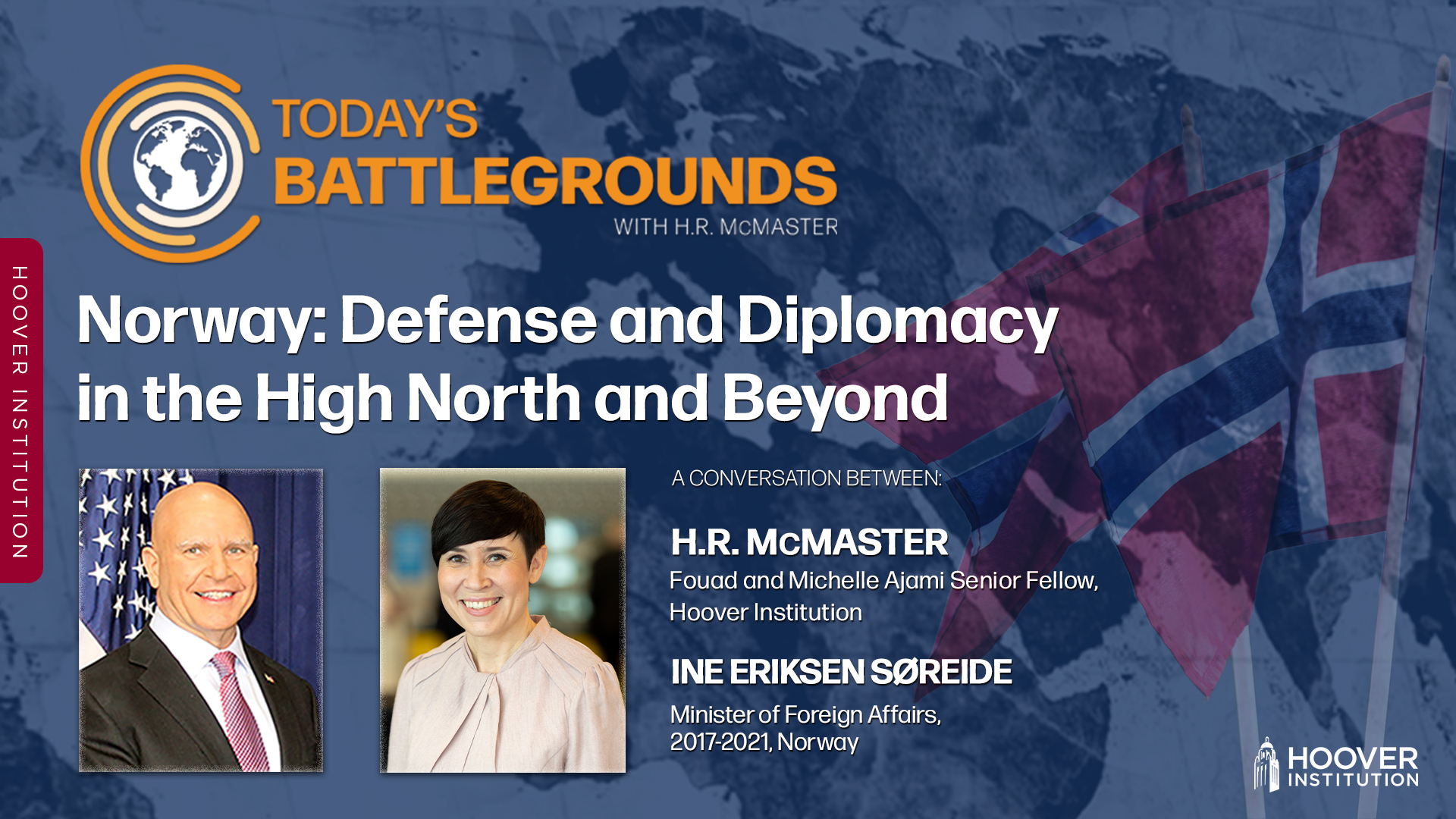
H.R. McMaster and Ine Eriksen Søreide discuss what it will take for Norway to protect critical infrastructure and preserve democratic resilience in this more dangerous European security environment.
August 13, 2026 • 48 Min Watch