










Videos
Can AI Libel You? The Robby Starbuck Case
Eugene Volokh and Jane Bambauer break down the groundbreaking Robby Starbuck v. Google case and what it could mean for AI, defamation law, and the future of free speech.
August 11, 2026 • 50 Min Watch
From eye surgery to missile defense, lasers have become an invaluable technology reshaping medicine, communications, manufacturing, and national security. Sound policy is needed to balance innovation, dual-use risks, and U.S. competitiveness in the laser age.
>> Speaker 1: When the first working laser was created in 1960, it was described as a solution looking for a problem. This technology, which can produce targeted waves of light with extremely high energy in only a few nanoseconds, has become essential. For a wide range of applications. Including communications, medicine, high-end chip production, defense, and manufacturing.
Lasers are considered to be an enabling technology, creating uses in applications that would otherwise be unaffordable or unfeasible. Take healthcare, traditional medical tools like saws and drills can easily damage bone tissue and are limited to simple cuts. Lasers, however, offer more precise, cleaner cuts with less damage to surrounding tissue.
LASIK eye surgery, for example, provides ultra-short laser pulses to remove small amounts of corneal tissue, reshape the cornea, and improve how light is focused onto the retina. Robot-guided lasers can now perform bone. Surgery with greater precision than traditional tools, enabling complex cutting trajectories reducing recovery time. Cancer treatments are now using laser-delivered proton beams to destroy tumors with minimal collateral damage.
In military applications, lasers provide major benefits over conventional systems. Their low cost per shot, greater magazine capacity, and greater effectiveness at providing defense. Against short-range missiles, drones, and satellites make them an ideal solution when efficient. And rapid respons are needed. Communication has been completely transformed by laser technology.
Fiber optic cables, the backbone of the Internet, rely on lasers to transmit Data. Companies like SpaceX use laser high-speed communication between satellites, allowing more data to be shared faster than previously possible in ground communication. Manufacturing also benefits from laser precision in drilling and 3D printing. Researchers are also experimenting with lasers that.
Range from 10 megajoules pulses for fusion. Research to 10 petawatts for laboratory astrophysics, more than the output of 10 million nuclear power plants. Since lasers aren't enabling technology, most public policy issues are specific to their applications. Such as medical procedures or directed energy. Weapons, rather than the lasers themselves.
Should technology serve dual use civilian and military purposes? Are such technologies environmentally safe? As advancements continue, questions like these will be imperative to the future of laser technology.
Videos
Eugene Volokh and Jane Bambauer break down the groundbreaking Robby Starbuck v. Google case and what it could mean for AI, defamation law, and the future of free speech.
August 11, 2026 • 50 Min Watch
Videos
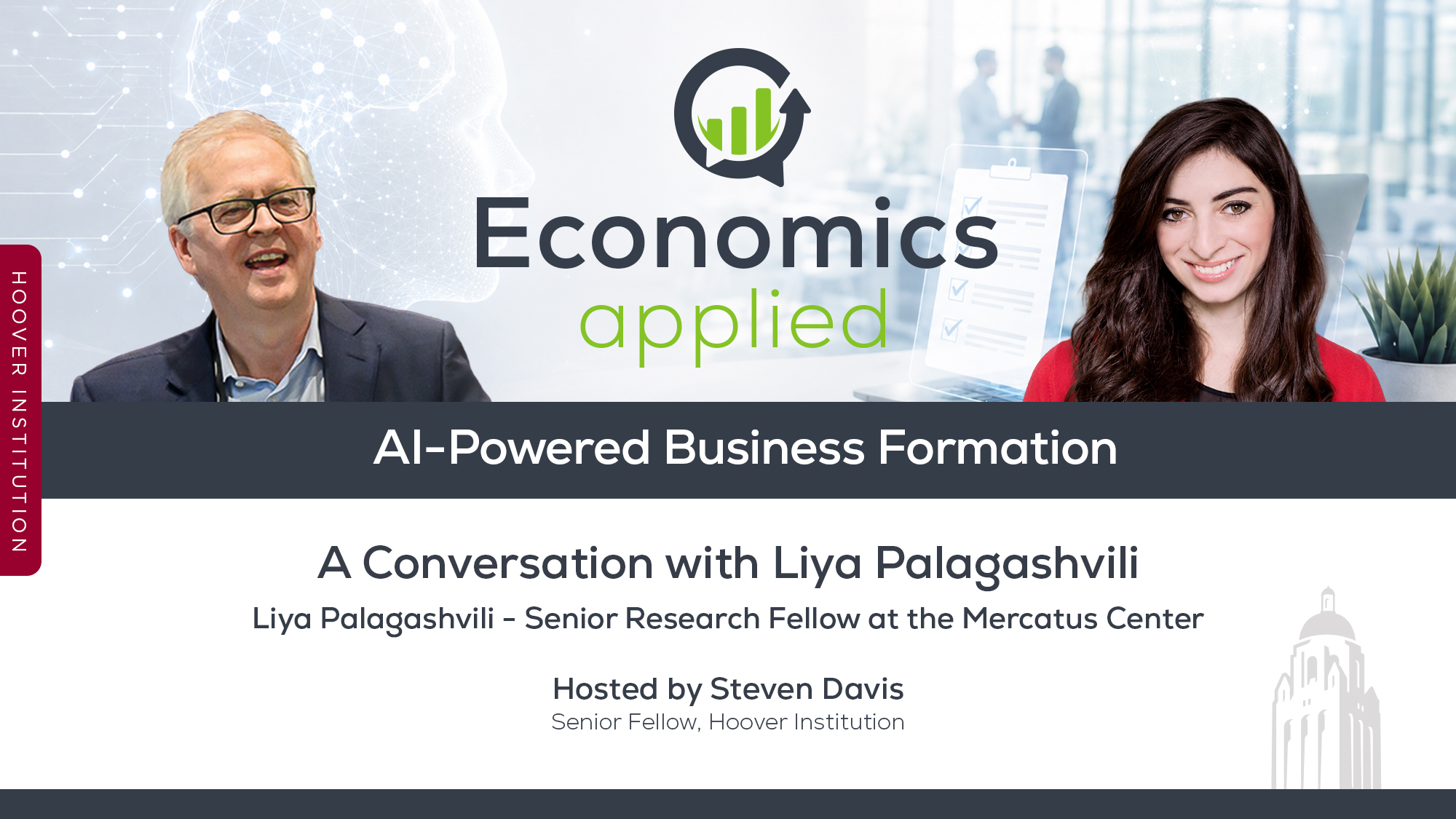
Are generative AI tools spurring a boom in solo businesses operated by a single person?
August 5, 2026 • 45 Min Watch
Videos
How fears of AI-driven unemployment are expanding the case for government intervention.
August 4, 2026