
Thomas Sowell’s Impact On Economics
How Thomas Sowell used economic history, evidence, and storytelling to challenge conventional wisdom and bring economics to the public.
October 1, 2026
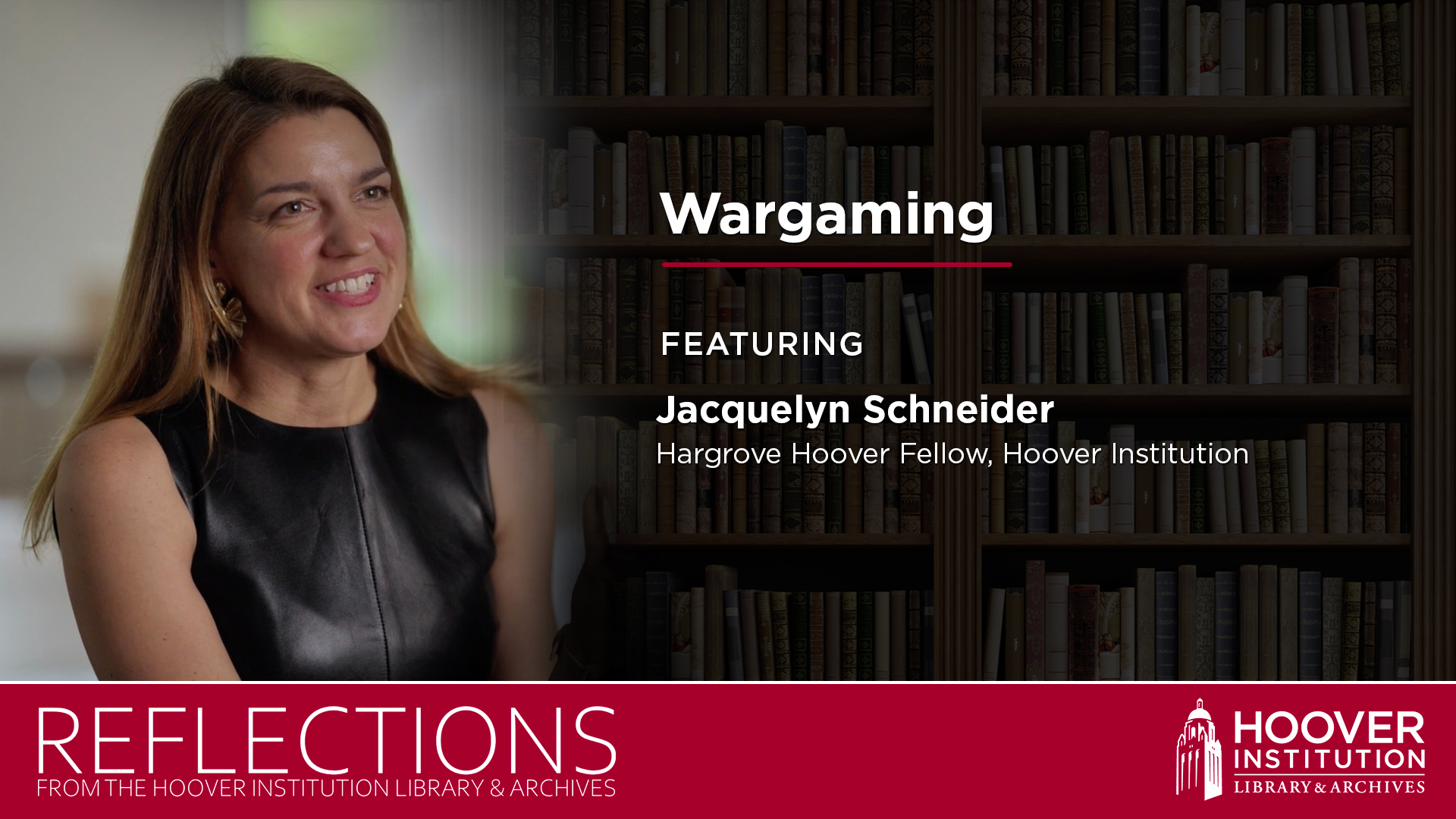
Hoover fellow Jacquelyn Schneider discusses the history of wargaming, how wargaming exercises can assist policymakers in times of crisis, and the rationale for the establishment of the Wargaming Archive at the Hoover Institution Library & Archives. To illustrate the importance of wargaming outcomes and assessments for policymakers and statesmen grappling with an unfolding crisis, Schneider discusses the Berlin Crisis Wargame, organized at Camp David in September 1961 as the construction of the Berlin Wall brought the US and the USSR to a high-stakes confrontation.
- When I came to Hoover and we had this extraordinary resource, the Library and archives, I realized that we had a way that we could play a really pivotal role in preserving and then using war games to understand some of the biggest questions of our time. I am the director of Hoover's War Gaming and Crisis Simulation Initiative. What we do at Hoover that makes us different, the first is we run our own games. So these are games that have a defined research question that we use an academic process in order to design. The other thing that we're doing, and I think this is actually what makes us unique in the world of who's doing war games, is building the archive. We're not just collecting the games, we're collecting the memos, the conversations, the the side pieces of historical evidence that help us understand the way in which these games were used for historical decision making. I call this the inner game in the outer game. So the inner game is the game you're playing in the war game, but the outer game is why you played that game in the first place and how that game ends up influencing the world afterwards. What we're doing in this archive is we collect the inner game, but we also do our best to collect the outer game. So we're giving you not just what was the outcome of the game, but what was the outcome in foreign policy decision making. Because of this game in August of 1961, the Berlin Wall goes up this game, the Berlin Crisis game is played less than a month later at Camp David, of all places, we're in a contentious kind of ongoing crisis with the Soviet Union over Berlin. We are at a time in our history where we're really considering whether we're willing to use nuclear weapons and trying to understand whether the Soviets are willing to use nuclear weapons. And so it feels like at that moment the stakes cannot be higher. So they're playing out this what starts it as, as a domestic episode and quickly escalates to an international kind of nuclear showdown between the US and the Soviet Union. The game was the brainchild of Thomas Shelling, A researcher at the Rand Corporation. Players included people like Henry Kissinger who was at the time, a young up and coming professor at Harvard University. What's interesting about the game is that both sides think they've won the crisis. Basically, you end at something close to a status quo where neither state has escalated to nuclear war, but there has been some level of conventional violence between the two states. And then when the Cuban Missile Crisis occurs in 1962, they talked about how influential their experience at Camp David was. The lessons they learned were lessons they took straight to the Cuban Missile Crisis. One of the initiatives that we have really prioritized the war gaming and crisis simulation initiative is making sure that these documents are at your fingertips, that students, researchers, those interested in history will be able to access these materials. So all of the materials that we are bringing in at the Hoover Institution Library and archives are digitized. And so any student can log on to or war gaming.hoover.org, and you'll find the materials. You can search by the war game, you can search by the subject, you can search by the time period, and then you can interact with these materials in the way that anybody could interact with these materials. And the hope is that we make history really easy to use and that we have a new generation of students that are using primary source documents, even at the undergraduate level in order to improve our understanding of history.
How Thomas Sowell used economic history, evidence, and storytelling to challenge conventional wisdom and bring economics to the public.
October 1, 2026
Everyone quotes Thucydides—but are we getting him right? Historian Andrew Novo joins Andrew Roberts to explore what the chronicler of Athens and Sparta really tells us about war, democracy, ambition, and human nature.
September 28, 2026
Articles
Twenty-five years after 9/11, the United States is confronting yet another era of profound uncertainty and potential dangers. The pace and scale of change are creating unforeseen disruptions that impact our security, stability, and prosperity. Advancing technologies are being adopted and applied in unexpected ways, sparking debates about the unintended consequences for human existence.
September 24, 2026