









VIDEO
Published: January 20, 2016
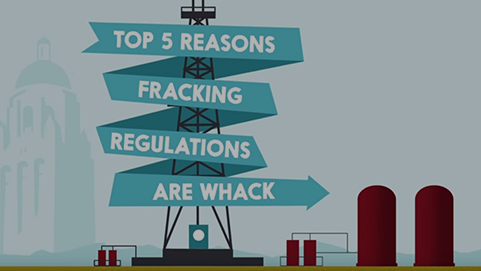
Requiring hydraulic fracturing operators to tag their fracturing fluids with tracers helps enforce the property rights of others who may be harmed. This, in turn, enables more use of insurance, surety bonding, self-regulation, and third-party verification/certification to reduce and protect against the real but rare risks of fracturing. Property rights hold producers accountable and take advantage of fracturing benefits.
Discussion Questions
- Another property rights-inspired approach would be the creation of a for-profit company that serves as a verification and certification entity. Fracturing well operators could contract with this company to verify that their wells meet certain standards. Underwriters Laboratories, Inc. (UL) provides a model for this approach, mostly for electronics and other consumer products. Since a company would be concerned both about its bottom-line and its reputation, there would be incentives to promote and ensure stringent best practices. Market pressures could increase the demand for certified and verified oil or gas thereby resulting in hydraulic fracturing operators contracting such a service. What do you think would be the benefits and drawbacks of such a system?
- Self-regulation functions best when the threat of government regulation is strong, thus incentivizing the industry to exert more pressure on bad actors to ensure consistent best practices. It is also more successful when the risky actions of one actor have a massively detrimental effect on the rest of the industry. An example of successful self-regulation is the nuclear power industry’s Institute of Nuclear Power Operation. The INPO sets “performance objectives, criteria, and guidelines for the nuclear power industry,” regularly inspects nuclear power plants, and assists plants in improving operation performance. In many ways, the INPO serves as an internal watchdog handling many of the normal regulatory roles. Discuss how a hydraulic fracturing self-regulatory organization could be designed and how it would oversee the industry.
- Surety bonding, insurance, or some combination of the two would promote best practices by making risky behavior prohibitively expensive. Shifting risk to a fiducially-responsible third-party creates a strong incentive to mandate good behavior. The insurance company would set common standards at a point where their expected policy payout would not exceed their expected premiums (or in the case of surety bonding, they would set the interest rate at a level where payout would not exceed interest payments). Since the cost of cleaning up contaminated water or the wreckage of an earthquake could be expensive, these insurance or surety bonding companies would either set their premiums or interest rates at levels high enough to cover the risks or to impose strict operating standards to make coverage affordable and manageable. The insurance or surety bonding company would then assume the regulatory role. Think about your daily life and how surety bonding and insurance either do or could play a role in changing your behavior by making you financially responsible for you actions.
More Like This
Related
VIDEO
Climate Anxiety and the Objectivity Crisis
Articles
Reducing Europe's Wildfire PM2.5 Spikes Through Privatizing Forests
Terry Anderson’s co-authored book Free Market Environmentalism is a must read for young people who are passionate about protecting the environment and who have mixed feelings about “cruel” capitalism.
August 3, 2026