Articles
America And China: The Race On The AI Frontier
The US head start is measured in months. To pull ahead, Americans must settle their AI fears and energize their hopes.
November 12, 2026
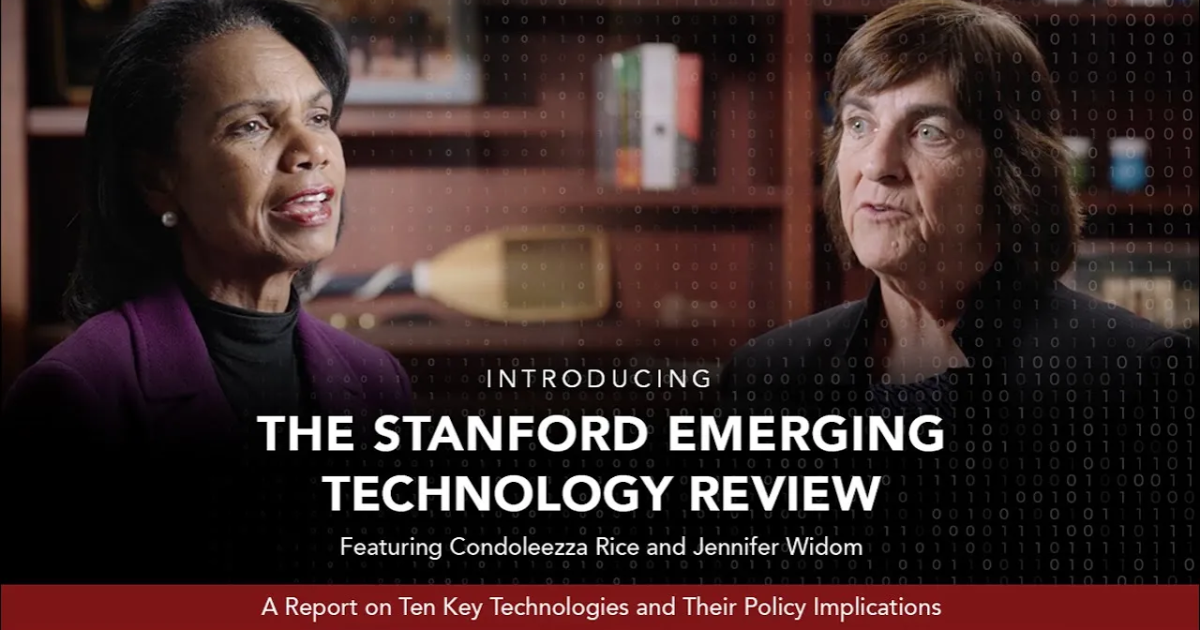
The Hoover Institution and Stanford University School of Engineering announced an innovative project and publication dedicated to exploring the breakthroughs and policy implications of cutting-edge technologies that are shaping our societies and economies.
In this video, the Review’s esteemed co-chairs, Condoleezza Rice, director of the Hoover Institution, and Jennifer Widom, dean of the School of Engineering at Stanford University, provide highlights of this unique collaboration. The partnership combines scientific expertise from leading Stanford researchers in ten emerging technology areas with policy insights provided by the Hoover fellowship.
Rice and Widom describe how the Review will conduct a comprehensive examination and analysis of the policy implications surrounding Artificial Intelligence, Biotechnology and Synthetic Biology, Space Technologies, and other critical areas. The video strongly emphasizes the imperative of using these technologies responsibly and sheds light on potential risks if autocracies and other malign actors gain undue advantages.
Further, the video underscores the pivotal role academia plays in nurturing scientific research and understanding. Rice and Widom illustrate how the Stanford Emerging Technology Review aims to initiate a vital conversation about navigating our rapidly evolving future. This dialogue, led by expert voices at the forefront of scientific research and public policy, emphasizes the necessity for responsible innovation and thoughtful consideration of the challenges that lie ahead.
Learn more about the Stanford Emerging Technology Review at https://setr.stanford.edu/.
Articles
The US head start is measured in months. To pull ahead, Americans must settle their AI fears and energize their hopes.
November 12, 2026
Articles
Drew Endy highlighted the need to secure the biotechnology frontier, as AI makes it ever more possible for bad actors to bring bioweapons to life. Abbas Milani provided personal and scholarly insights into the conflict in Iran and the country's democratic potential.
November 11, 2026
Videos
Cryptography secures nearly every bit of our daily digital interactions, from messaging to banking and cryptocurrencies. Yet rapid advances in quantum computing could threaten existing encryption, while the growing use of blockchain raises new questions about privacy, the risks of illicit finance, government oversight, and the future of digital trust.
September 9, 2026