
Thomas Sowell’s Impact On Economics
How Thomas Sowell used economic history, evidence, and storytelling to challenge conventional wisdom and bring economics to the public.
October 1, 2026
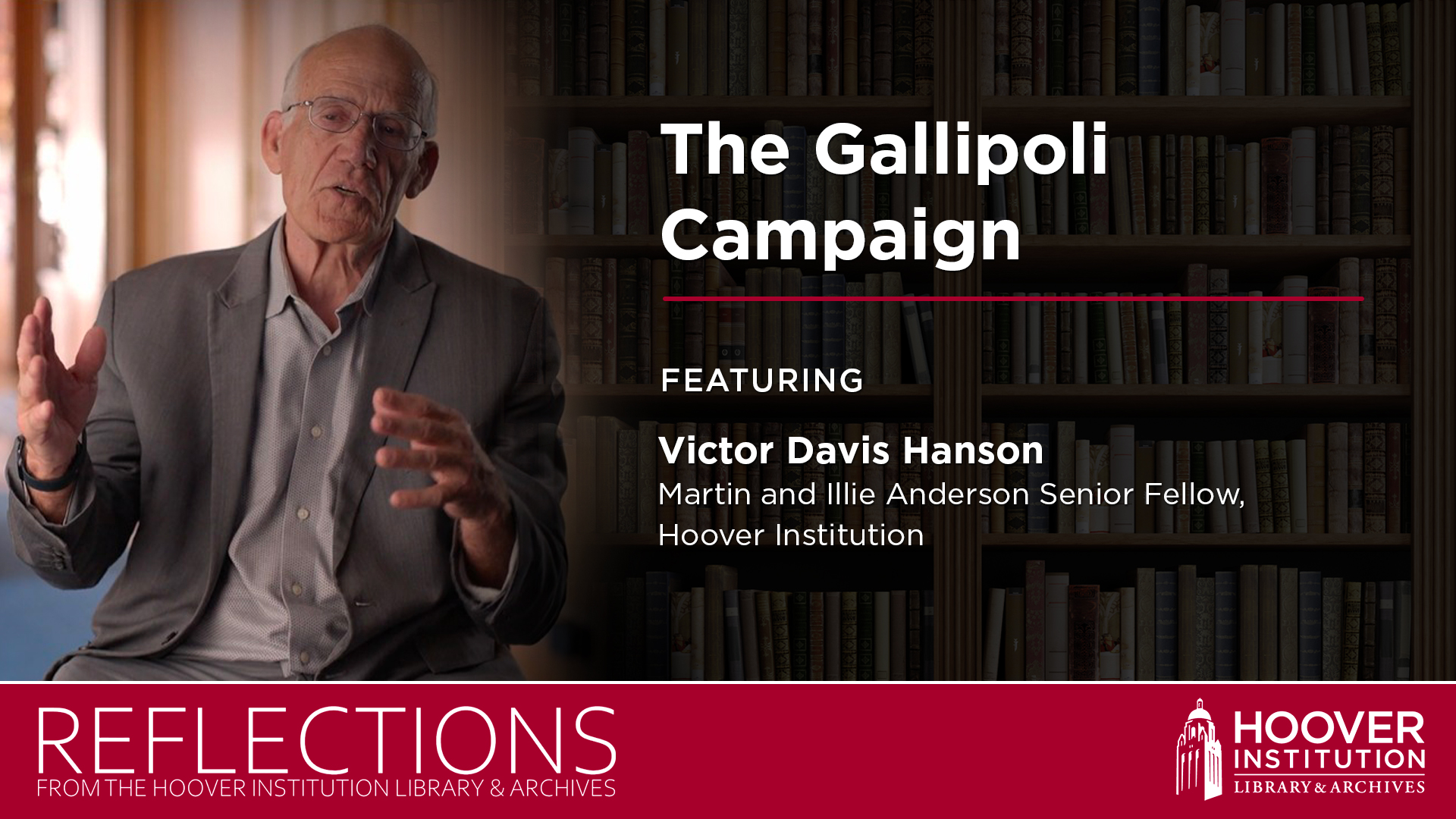
Hoover Senior Fellow Victor Davis Hanson discusses the disastrous Gallipoli Campaign of World War I, as depicted in the sketchbook of Lieutenant Colonel M.J.W. Pike, commanding officer of the 5th Service Battalion, Royal Irish Fusiliers, with the 31st Infantry Brigade. Pike’s drawings, which are housed at the Hoover Institution Library & Archives, convey the stark contrast between the beautiful landscape of the Gallipoli Peninsula and the horrors of the trench warfare that took place there in 1915–1916. Winston Churchill championed the expedition, which resulted in a Turkish victory over the Allied forces.
- When military historians think of Gallipoli, they think of the futility of a quick fix. During World War I, the campaign was dreamed up by Winston Churchill. The result was that the British fleet was almost wiped out and you had a quarter million casualties for nothing. The Gallipoli campaign was intended as a very, very brief, successful effort to go through the Darnells with a big fleet bombard Istanbul, open up the Black Sea, and knock Turkey out of the war. Originally, it seemed a very simple idea. They were gonna resupply Russia through the Black Sea and make more Russian pressure on the eastern front of the German army. They quickly lost about 70% of their surface ships. They could not make it into the Sea of Marmora. In late April 1915, they'd landed on the Gallipoli Peninsula on the northwest side of the channel. A majority were British troops, about 80,000. They were supplemented by about 20,000 Australian and New Zealand troops, and then somewhere between 50 and 60,000 French troops. And they tried to dislodge the fortifications and the art- artillery. And the result of that was the Turks began to pour in troops, and it just kept escalating. And they reached a deadlock, and after eight months of the campaign by late December and January, be set with disease, dysentery, and typhus. They suffered altogether the allies, about 250,000 dead wounded, missing. They had to withdraw. It was a disaster. I've been to Glipili a number of times, and it's quite striking. It's, it's kind of a cauldron of world military history because of its key, key location. Remember, this is the only way into the Black Sea. Gallipoli had a lot of consequences. On the Turkey side, it energized the career of Kamela out of Turk. He would go on to be the major political and military figure in Turkey. His authority originated from his brilliance at Gallipoli. On the other side Winston Churchill, who had been the head of the Admiralty was completely disgraced. Fairly or not, the reputation came that he was eccentric and couldn't always be trusted on matters of military. Colonel M.J. W. Pike was an Irish officer attached to the British Army, and he happened to be a, a gifted artist. So during the landings and the effort to break out, he made a number, I think, two dozen sketches. And the sketches are everyday life of what it was like in the trenches, where the encampments were very clear and sophisticated maps. But most importantly, he had an eye for landscape. So you get a real picture of the, sort of the coast ranges of California-like environment, rolling hills contrasted with the blue water of the Agian and the channel. He had an idea that really was trying to show you what a beautiful place this infernal takes place in. He's got a very brilliant sketch moving where he shows you that almost in stair-like fashion, there's a series of white tents that go all the way down the slope of these foothills to the, the sea. Another one that's really moving is when we say channel or darden ales, we don't really get the idea that it's a very busy channel, even during war. And he has two or three sketches where there's a whole array of ships and the channel looks really packed. We're very lucky to have the Pike Sketchbooks at the Hoover Institution Library and Archives. It's something that gives us a firsthand view of what the soldiers were seeing every day, and it's a brilliant compliment to the, the traditional military history that doesn't really have that ground up ability to capture the flavor or the tragedy of the battle.
How Thomas Sowell used economic history, evidence, and storytelling to challenge conventional wisdom and bring economics to the public.
October 1, 2026
Everyone quotes Thucydides—but are we getting him right? Historian Andrew Novo joins Andrew Roberts to explore what the chronicler of Athens and Sparta really tells us about war, democracy, ambition, and human nature.
September 28, 2026
Articles
Twenty-five years after 9/11, the United States is confronting yet another era of profound uncertainty and potential dangers. The pace and scale of change are creating unforeseen disruptions that impact our security, stability, and prosperity. Advancing technologies are being adopted and applied in unexpected ways, sparking debates about the unintended consequences for human existence.
September 24, 2026